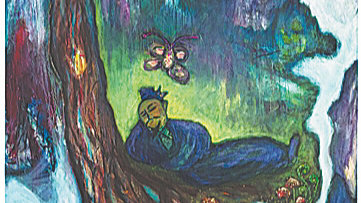
Zhuang Zhou
Introduction
Zhuang Zhou, more commonly known as Zhuangzi, was a renowned Taoist philosopher who is believed to have lived around the 4th century BC. His teachings and philosophies have left a profound impact on Chinese thought, particularly through his advocacy for achieving spiritual freedom by living without desire. The philosophy of Zhuangzi, most vividly captured in his text "Xiao Yao You" (Wandering Beyond), encourages a life of spiritual liberation and detachment, and has been a source of inspiration for artists and philosophers alike.
Philosophical Beliefs
Zhuang Zhou's philosophy is central to Taoist thought, emphasizing the importance of harmony with the Tao, or the natural way of the universe. Central to his teachings is the idea of transcending worldly desires and illusions to attain true freedom. In "Xiao Yao You", Zhuangzi espouses the notion of living beyond the constraints of societal norms and desires, advocating for a return to natural simplicity and spontaneity. This philosophy is often illustrated through allegorical tales and parables, which reveal the relativity of human conceptions of life, death, and reality.
Core Teachings
Central to Zhuang Zhou’s teachings is the principle of wu wei or non-action, advocating for a natural alignment with the Tao. Zhuangzi’s narratives often feature characters who achieve serenity by surrendering to the flow of life, embodying the Taoist ideal of harmony with nature and the universe. His philosophical anecdotes emphasize the futility of rigid distinctions and the importance of embracing a flexible, adaptive approach to life.
Zhuangzi's Texts and Interpretations
The Zhuangzi text consists of stories and maxims that exemplify the nature of the ideal Taoist sage. It contains numerous anecdotes, allegories, parables, and fables, often expressed with irreverence or humor. Recurring themes include embracing spontaneity and achieving freedom from the human world and its conventions. The text aims to illustrate the arbitrariness and ultimate falsity of dichotomies normally embraced by human societies, such as those between good and bad, large and small, life and death, or human and nature. In contrast with the focus on good morals and personal duty expressed by many Chinese philosophers of the period, Zhuang Zhou promoted carefree wandering and following nature, through which one would ultimately become one with the "Way" (Tao).
Though appreciation for the work often focuses on its philosophy, the Zhuangzi is also regarded as one of the greatest works of literature in the Classical Chinese canon. It has significantly influenced major Chinese writers, poets, and artists across more than two millennia.
Influence on Art and Culture
The ideas of Zhuang Zhou have deeply influenced Chinese art and culture. His notion of spiritual wandering and boundlessness is often reflected in Chinese ink-brush works, calligraphy, and landscape paintings. Modern exhibitions, such as "An Invitation to a Carefree Wandering," highlight how contemporary artists draw upon Zhuangzi’s texts to express themes of spirituality and boundlessness. These artworks, characterized by a romantic style, capture the essence of Zhuangzi's teachings and continue to inspire modern interpretations of Taoist philosophy.
Impact on Taoism
Zhuang Zhou’s contributions are pivotal in shaping Taoist philosophy, offering profound insights into the nature of reality and the human condition. His writings provide a counterpoint to Confucianism by prioritizing individual freedom and spiritual enlightenment over social conformity and hierarchical order. The playful yet profound teachings of Zhuangzi resonate with Taoist practitioners and philosophers, continuing to influence spiritual practices and philosophical discourse.
Zhuang Zhou remains a seminal figure in Chinese philosophy and culture, whose teachings on spiritual freedom and harmony with nature continue to inspire and provoke thought. His enduring influence spans across various forms of art, literature, and philosophy, highlighting the universal appeal and timeless relevance of his ideas. As contemporary artists and thinkers revisit Zhuangzi’s works, they find new ways to interpret his vision of a world where true happiness lies in the simplicity of being and the acceptance of life’s mysteries.








